Navigating the Fuel Squeeze: How J.B. Hunt’s Q3 Warning Highlights Broader Freight Market Pressures

Recent developments in the North American transportation and logistics sectors have placed a renewed spotlight on the intricate economics of fuel pricing, operational cost inflation, and contractual rigidity. Last week, transportation giant J.B. Hunt Transport Services issued a rare and unexpected financial warning, signaling a projected 5% to 10% earnings headwind for the third quarter. The primary drivers behind this financial pinch are escalating fuel expenses and rising driver compensation costs, which have outpaced short-term adjustments in the company’s operating models.
This warning immediately rattled investor confidence, causing the company’s shares to sink roughly 12% in subsequent trading sessions. However, industry analysts and market observers emphasize that the stock market’s sharp punishment may reflect a temporary giveback following potentially inflated margins in the second quarter, rather than an existential, long-term threat to the carrier’s robust business model. To fully understand why J.B. Hunt and other major logistics providers are grappling with these cost pressures, one must examine the mechanics of retail versus wholesale fuel pricing, the structural limitations of long-term intermodal and dedicated contracts, and the contrasting challenges faced by smaller, spot-market-reliant trucking fleets.
The Mechanics of Fleet Fuel Procurement: Retail Versus Wholesale
To comprehend how rapid fuel spikes impact large-scale carriers, it is essential to analyze the dual pricing structures that govern the diesel market. Major national fleets possess the corporate scale and buying power required to negotiate bulk fuel purchases at rates closely tied to wholesale benchmarks, commonly referred to in the industry as the "rack" price.
Instead of paying standard retail prices posted at public truck stops, large carriers typically secure fuel through complex supply agreements structured as a premium over the daily wholesale rate—for instance, the rack price plus 2%. Under this arrangement, if the benchmark wholesale price sits at $3.89 per gallon, the carrier’s actual acquisition cost would be approximately $3.97 per gallon.
To mitigate the inherent volatility of commodity markets, most carriers implement fuel surcharge programs designed to pass a significant portion of diesel cost fluctuations onto shippers. Because standard fuel surcharges are traditionally pegged to retail diesel price indices—such as the Department of Energy’s retail averages—carriers theoretically maintain a financial buffer when fuel prices swing upward.
Nevertheless, the effectiveness of this buffer is not static. It fluctuates in direct response to broader market competitiveness and fuel cost stability. In highly competitive market environments characterized by stable fuel prices, carriers frequently compress their base freight rates to secure volume, inadvertently exposing themselves to heightened vulnerability if fuel prices suddenly spike. Conversely, when tight capacity allows carriers to command higher base rates, their long-term exposure to fuel price volatility is substantially diminished.
Contractual Lags and the Intermodal Margin Squeeze
The core operational challenge currently confronting J.B. Hunt lies within its dedicated contract carriage and intermodal divisions. Unlike spot-market transactions, which adjust dynamically on a daily or weekly basis, dedicated and intermodal contracts are typically negotiated over much longer terms—often spanning one to three years—and are rarely renegotiated mid-cycle.
A significant portion of J.B. Hunt’s current long-term contracts were established prior to a broader freight market inflection point that materialized between late 2025 and early 2026. During that preceding period of heightened competition and compressed operating margins, carriers priced these multi-year contracts aggressively to capture market share and maintain asset utilization. Consequently, when the market environment shifted and operating cost inflation accelerated, these locked-in rate structures left the company heavily exposed.
The widening or narrowing of the "fuel spread"—the economic differential between retail and wholesale diesel prices—provides a clear quantitative illustration of this phenomenon. Wholesale diesel prices, functioning as traditional commodity benchmarks, exhibit substantially higher volatility than retail prices. Fuel retailers purchase product in massive bulk quantities and utilize sophisticated hedging and inventory management strategies to smooth out price fluctuations for end consumers over time. Wholesale markets, by contrast, operate as dynamic, highly responsive free markets negotiated on a daily basis.
During periods of rapid economic and commodity inflation, wholesale diesel costs ascend far more rapidly than retail price indices. Consequently, large carriers find themselves procuring fuel at elevated wholesale rates before their fuel surcharge mechanisms—which rely on slower-moving retail benchmarks—have time to catch up. This lag manifests as a compressed retail-wholesale fuel spread.
Historical data from the trucking sector demonstrates this cyclical compression. Between early July and mid-September, daily retail diesel prices rose by approximately 31%, while wholesale prices climbed at more than double that rate. This asymmetric acceleration narrowed the retail-wholesale fuel spread by nearly 48% over the same timeframe. Since early July, the spread has averaged just over $1.00 per gallon, representing a noticeable decline from the $1.25 average maintained from 2022 through March of the current year.
By contrast, the period spanning from April to July featured an average fuel spread exceeding $1.50 per gallon, providing carriers with substantial margin tailwinds. Industry experts suggest that the market’s enthusiastic valuation of J.B. Hunt during the second quarter may have over-indexed on those favorable spreads, making the third-quarter adjustment a natural, albeit painful, normalization.
Divergent Realities: The Plight of Smaller Fleets
While large-scale carriers contend with the complexities of wholesale procurement spreads and long-term contract lags, small and medium-sized fleets face an entirely distinct set of economic pressures. Independent owner-operators and small trucking companies generally lack the purchasing volume necessary to negotiate wholesale rack-pricing agreements. Instead, they purchase fuel at standard retail pump prices, leaving them directly vulnerable to immediate cash-flow shocks when diesel prices surge.
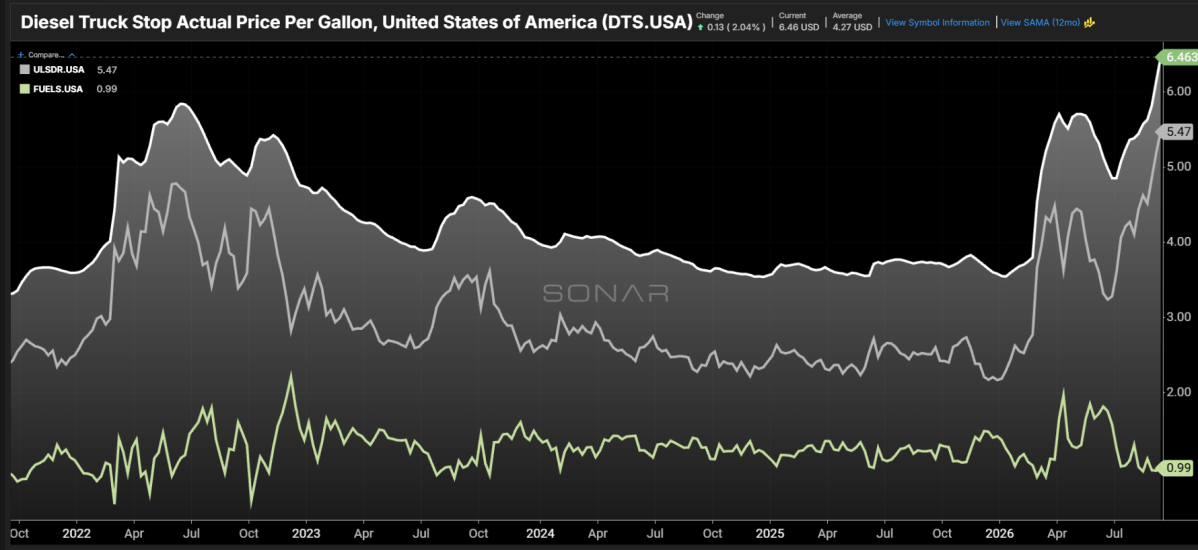
Passing these sudden retail cost increases along to shippers is notoriously difficult in the spot market, particularly in a freight market characterized by stagnant or declining spot rates. Recent industry charts indicate that retail diesel prices paid by smaller fleets have climbed roughly 24% over a three-month period. Simultaneously, national spot market rates have trended downward by approximately 6%.
This inverse relationship—where operating costs rise sharply while revenue generation per load contracts—creates severe margin erosion for smaller operators. Unlike large carriers with diversified revenue streams and structured contract portfolios, small fleets operate on razor-thin margins with minimal financial reserves. They possess no guaranteed mechanism to recoup these lost margins retroactively; their financial survival is entirely dependent on immediate market rate corrections that may or may not materialize in a softer freight environment. Furthermore, as fundamental economic principles dictate, end consumers will only absorb added transportation costs if alternative shipping capacities are entirely exhausted.
Broader Industry Implications and Outlook
J.B. Hunt’s recent third-quarter warning serves as a bellwether for the broader logistics and transportation ecosystem. It underscores the fragility of supply chain margins in an environment characterized by unpredictable commodity swings, lingering driver wage pressures, and rigid contractual obligations.
For enterprise shippers, the situation highlights the growing necessity of flexible partnership models. As carriers absorb the short-term shocks of compressed fuel spreads and inflationary cost structures, shippers may need to engage in more collaborative, transparent rate negotiations that account for rapid macroeconomic shifts rather than relying on outdated, static multi-year agreements.
As the industry prepares for upcoming sector events—such as the upcoming FreightTech conferences and broker compliance symposia where logistics leaders will debate risk management, regulatory compliance, and technological advancements—operational adaptability remains the paramount defense against market volatility. While J.B. Hunt’s financial readjustment has introduced short-term turbulence for its investors, the broader macroeconomic data suggests that the current margin compression is a cyclical adjustment within a normalizing freight landscape rather than a permanent structural decline.